












New in assortment - apple - late (Malus domestica 'ZVONKOV�')21.10.2026
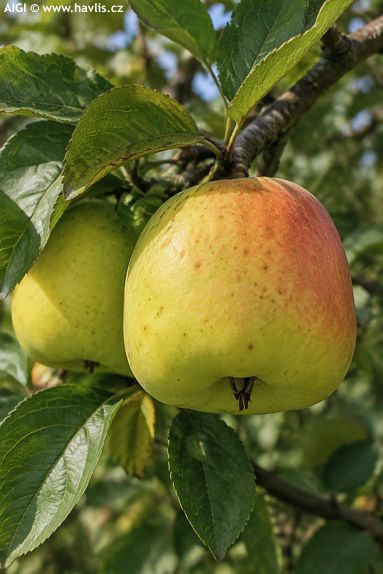
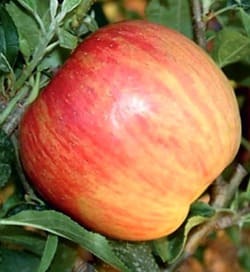
Glockenapfel (Zvonkov� in Czech) is one of those historic winter apples that can be recognised at a glance. Its tall, almost sculptural fruits resemble an old bronze bell, which inspired both its German name Glockenapfel and the French synonym Pomme Cloche. The fruits are medium to large, with a pale yellow to greenish-yellow skin that may develop a delicate orange-red blush on the sunny side. The flesh is silvery white, firm, crisp, and pleasantly crunchy. Its flavour is refreshingly tart with subtle spicy undertones and never feels heavy or excessively sweet. This is not an apple that reveals its full character immediately after harvest. Its greatest virtue is patience. Picked from mid to late October, it develops its finest eating quality only during the winter months, when the flavours become rounder, more harmonious, and better integrated. It is no coincidence that Glockenapfel is regarded as one of Europe's classic keeping apples. In a traditional fruit cellar, it stores well into spring, while modern controlled-atmosphere storage close to 0�C can preserve the fruit until early summer. In Switzerland it remains particularly valued for apple strudel, as the flesh holds its shape during baking instead of collapsing into puree, while its lively acidity provides welcome balance in rich pastries.
The tree is vigorous when young, initially producing a narrow, strongly upright crown that gradually broadens with age and develops an elegant, slightly pendulous habit. Growth naturally slows as the tree matures and settles into reliable cropping. Historically, Glockenapfel was most grown as a standard tree on seedling rootstocks, where its longevity and capacity to remain productive for decades could be fully appreciated. Today, MM106 remains an excellent choice for medium-sized garden trees, while M9 is often selected for smaller forms and more intensive plantings. The qualities of this cultivar have also been utilised in breeding programmes, most notably as one of the parents of the well-known German variety Gloster 69. Glockenapfel is self-sterile and belongs to Pollination Group 3. Suitable pollinating partners include cultivars from Groups 2, 3, and 4, such as James Grieve, Cox's Orange Pippin, Discovery, Elstar, Golden Delicious, Idared, Jonathan, Spartan, and Ontario.
The exact origin of Glockenapfel remains uncertain. The National Fruit Collection records it as a historic cultivar long associated with Switzerland, while German pomological literature places its roots somewhere within the wider region of southern Germany and the Swiss borderlands. Neither its original discoverer nor breeder is known, which is not unusual for ancient European fruit cultivars. Under names such as Altl�nder Glockenapfel, Schweizer Glockenapfel, Echter Glockenapfel, and Weisser Winterglockenapfel, it has been cultivated since at least the first half of the 19th century. Modern plant patents and breeders' rights do not apply to this historic variety. Its reputation for exceptional storage life and dependable productivity has allowed it to survive long after many contemporary cultivars disappeared from orchards and collections.
Last revision 20‑10‑2026
New in assortment - apple - self-fertile - medium late (Malus domestica 'SPARTAN')19.10.2026
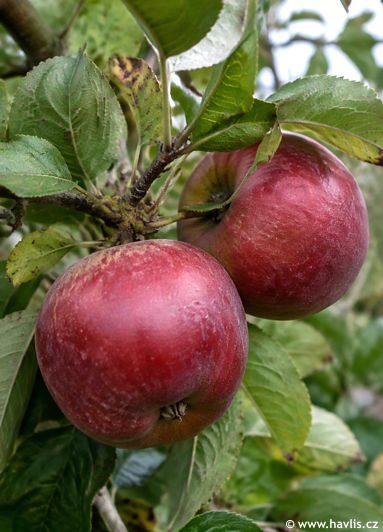
Spartan is one of those apple tree cultivars that earned worldwide popularity not through novelty, but through an exceptionally balanced combination of qualities. When the first trees reached the market in the 1930s, growers quickly recognised it as a worthy successor to the beloved McIntosh. The fruits are medium to large, neatly rounded to conical in shape, and almost entirely covered with a deep burgundy to purplish-red skin that glows like polished garnet in sunlight. Beneath the skin lies snow-white, fine-textured, crisp, and exceptionally juicy flesh. The flavour is beautifully balanced, combining sweetness and refreshing acidity with a distinctive vinous character that has become Spartan's trademark in English pomological literature. This is not an apple that relies on extreme sweetness or exotic flavours to impress. Its strength lies in purity, balance, and consistency, qualities that have kept it among the most respected dessert apples of the Northern Hemisphere for nearly a century. The fruit is usually harvested in early October and reaches its best eating quality from November through January. While the flesh remains firm during storage, some of its characteristic aroma gradually fades over time. The tree is highly productive and often sets such heavy crops that fruit thinning becomes necessary to maintain good fruit size. In return, it offers reliable yields and straightforward cultivation, qualities that have made it one of Canada's most successful apple cultivars.
Spartan forms a moderately vigorous tree with an upright to broadly spreading crown and abundant fruiting wood. It is equally suitable for smaller gardens and more intensive orchard plantings. On M9 rootstock it develops into a compact tree ideal for limited spaces and trained forms, while MM106 remains an excellent choice for traditional garden orchards, providing a good balance between growth and productivity. The cultivar was bred in 1926 at the Summerland Experimental Station in British Columbia, Canada, by R. C. Palmer and was commercially introduced in 1936. For more than half a century it was believed to be a cross between McIntosh and Yellow Newtown Pippin. Modern genetic studies have since demonstrated that Yellow Newtown Pippin could not have been the pollen parent. What is known with certainty is that McIntosh served as the seed parent, while the identity of the pollen parent remains a mystery. This unusual combination of documented heritage and unresolved parentage makes Spartan one of the more intriguing stories in modern pomology. Spartan belongs to RHS Pollination Group 3, and for reliable cropping it benefits from another compatible apple cultivar flowering nearby. Suitable pollination partners include James Grieve, Discovery, Elstar, Jonathan, Cox's Orange Pippin, and Golden Delicious. A major advantage of Spartan is its good resistance to apple scab and powdery mildew, although it may be somewhat susceptible to canker in regions with persistently damp conditions.
Last revision 20‑10‑2026
New in assortment - sea holly (Eryngium 'LAPIS BLUE')19.10.2026
.jpg)
Lapis Blue sea holly is the bluest gem you can dream of planting in a garden, without having to hire a gang of mining sprites and open your own mine. Its flower heads display a shade of blue that would look perfectly at home among the finest sapphires and lapis lazuli stones. From a basal rosette of strikingly marbled and delicately dissected leaves emerge sturdy, upright stems in summer, each topped with cylindrical flower heads measuring around 4.5 to 5 cm across and surrounded by long, spiny bracts that give the plant an almost exotic appearance. Flowering from June to August, it develops its most intense metallic-blue coloration in full sun, when the flower heads, bracts and upper stems are bathed in light.
Although we have always had a particular fondness for sea hollies, none of the varieties we have grown so far has matched the richness of blue displayed by 'Lapis Blue'. It forms a compact, densely branched clump approximately 40 to 50 cm tall and, thanks to its sturdy growth, requires no staking. Although it is sometimes listed as a selection of Eryngium bourgatii, its more robust habit, larger flower heads and exceptional intensity of colour make it resemble the garden hybrids of the Eryngium � zabelii group more closely. The name 'Lapis Blue' itself refers to the lapis lazuli gemstone, whose deep blue hue this cultivar captures with remarkable accuracy.
Zabel�s hybrid sea hollies can give a garden structure and colour without any effort. They perform best in dry perennial plantings, where their metallic blue flower heads contrast beautifully with the warm tones of summer plants, such as yellow and ochre rudbeckias, light brown ornamental grasses or low gypsophilas. I planted mine in the centre of a bed with a mix of low sedums in various foliage colours, alternating with several warm‑toned coreopsis, and the rhythm it creates through summer is fantastic. Thanks to firm stems, they also thrive in windy positions where other perennials flop, and in urban plantings where they tolerate heat, dust and prolonged drought. Their long‑lasting flower heads make them an excellent cut flower as they keep their shape and colour in the vase, and if you wish to dry them, cut the stems at peak colour and hang them upside down in a warm, dark room.
Last revision 19-10‑2026
New in assortment - columnar apple - medium late (Malus domestica 'REDLANE')18.10.2026
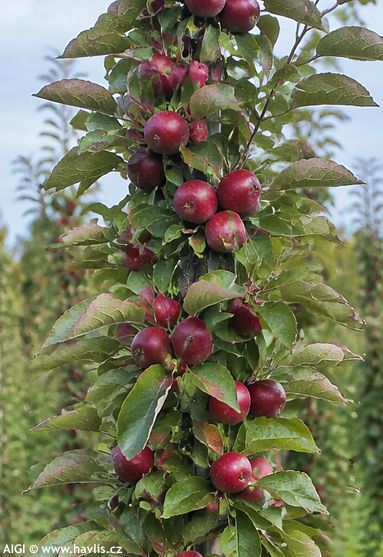
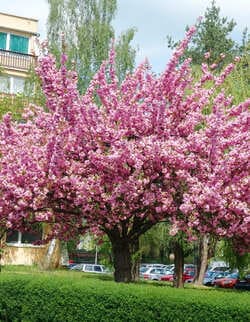
Redlane is one of the most striking columnar apple trees available today, often resembling a narrow flowering cherry in full bloom. In spring, its slender crown nearly disappears beneath a mass of deep pink blossoms, while in autumn it becomes decorated with dozens of glossy purple-red apples that look like Christmas ornaments hanging directly from the trunk. Although grown primarily as an ornamental apple, its fruits are edible and significantly larger than those of most ornamental crab apples. Reaching about 5 cm in diameter, they are elongated-ellipsoid in shape, with a yellow base almost entirely covered by a washed purple-red overcolour and completely free of russeting. The real surprise comes when the fruit is cut open: the flesh is pinkish-red and rich in juice, capable of colouring juices, jellies and ciders into beautiful ruby shades. It is medium-firm, exceptionally juicy, pleasantly tart and only lightly aromatic. For this reason, 'Redlane' is valued less as a dessert apple and more as a unique processing variety, where both its colour and juiciness can be fully appreciated. The fruits ripen from late September to early October, and the tree enters bearing early and reliably. Light fruit thinning promotes regular flowering and consistent crops. The fruits are not suitable for long-term storage. Hardy to at least -30 �C.
The tree has a compact, narrow columnar habit and grows with medium to strong vigour, making it ideal for small gardens, urban front yards and large containers. It carries genetic resistance to apple scab and shows very good tolerance to powdery mildew, making it one of the least troublesome red-fleshed apple cultivars available. It is a diploid variety that flowers from early to mid-season and belongs to pollination group 3. Although often described as partially self-fertile, it produces heavier and more regular crops when planted near compatible pollinators such as 'Topaz', 'Rajka', 'Rub�n', 'Gala', 'Golden Delicious' or 'James Grieve'. 'Redlane' originated from a cross between 'Maypole' and UEB 2345/1 and has been protected under European Community Plant Variety Rights (EU 26965) since 2010.
Last update: 18-10-2026
New in assortment - apple - medium late (Malus domestica 'COX'S ORANGE PIPPIN')18.10.2026
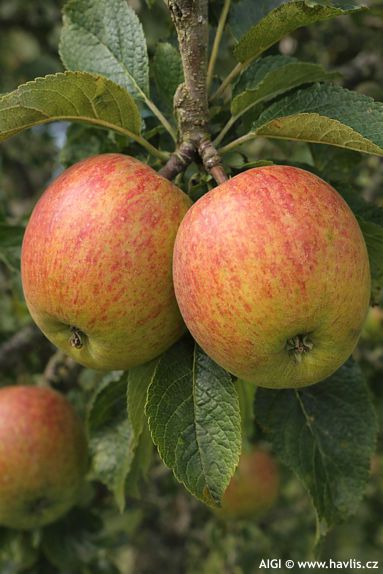
Cox�s Orange Pippin is an old mid‑late apple cultivar whose fruits are medium‑sized, orange‑yellow with fine red striping. The flesh is tender and juicy, with the unmistakable �Cox aroma� said to be recognisable even blindfolded � a blend of flowers, musk, citrus and autumn. The flavour is well-balanced sweet and sharp, rich and layered, with a long finish and a distinctive spicy note typical of Cox�s apples. The tree grows with medium vigour and forms a dense, compact crown that needs regular thinning to let in light. It is known for its higher demands: it needs warmth, full sun and good soil. It is more susceptible to scab and powdery mildew, so careful orchard hygiene is essential. The fruits are harvested from late September to early October and, under good storage conditions, keep until December or January. It is a cultivar best enjoyed fresh � its aroma is so pronounced that it is often used in pies, strudels and juices, adding depth and character. Suitable pollinators include James Grieve, Discovery, Gala, Rubin, Idared, Elstar, Spartan, Florina, Cortland and Golden Delicious. Its cold hardiness reaches approximately �30 �C (USDA zone 5).
Cox�s Orange Pippin is a cultivar with a story. It was discovered by the English gardener Richard Cox (1766�1845), a former brewer who, after retiring, bought a small house in Farnham, Buckinghamshire, and devoted himself to what he loved most � his garden. He grew roses, ornamental shrubs and fruit trees, and it was there, among flower beds and old apple trees, that around 1825 a seedling appeared which changed his life. It was not a planned cross but a fortunate accident: a seed from unknown pollination germinated and produced a tree whose fruits had a fragrance Cox had never encountered before. Local gardeners began asking for grafts, pomological societies listed it in their catalogues, and within a few decades Cox�s Orange Pippin became an icon of Victorian gardens � an apple appearing on tables, in cookery books and in competitions for �the finest dessert apple of England�. Although several cultivars bearing his name exist in modern registers, most of them arose long after his death as clones, mutations or regional selections. Richard Cox himself raised several experimental seedlings, but they were more horticultural attempts than true discoveries � none matched the quality or fame of the original Cox�s Orange Pippin.
Last revision 18‑10‑2026
New in assortment - apple - medium late (Malus domestica 'SANTANA')18.10.2026
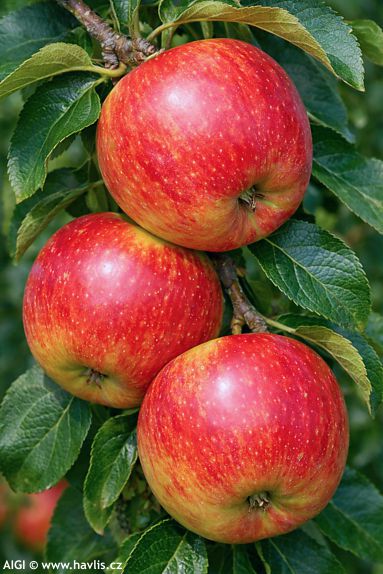
Santana is now among the most sought‑after apple cultivars, not only for its excellent flavour but also for its very low allergenic potential, making it suitable for many people who react to common apples (it contains only small amounts of PR‑10 proteins). The fruits are medium to large, almost round and nicely uniform, with smooth skin that turns from yellow‑green to deep red in autumn, sometimes as a single blush, sometimes as a marbled overlay. The flesh is cream‑yellow, juicy and crisp, with a sweet‑tart profile inherited from its parent Elstar � fresh, bright, with a gentle spicy note that becomes rounder after a few weeks of storage. The aroma is clean and distinctly appley, without any mealy tones. It is a mid‑late to late cultivar that ripens from late September to early October; the fruits can be eaten immediately after picking, although a few weeks of storage give them a rounder and fuller flavour. Storage life is excellent: in a standard cold room the fruits keep until February or March without losing juiciness, and in commercial cold stores close to 0 �C they can last well into summer. They are ideal for fresh eating, salads and baking, as they hold their shape and do not release excess moisture. Hardy to about -34 �C (USDA zone 4).
The tree grows at a medium rate, forming a naturally pyramidal and rather open crown that allows good light penetration and reliable colouring even inside the canopy. Disease resistance is strong: the Vf gene provides high resistance to apple scab, while the cultivar is more susceptible to powdery mildew, which should be monitored especially in warm and dry regions. �Santana� is self‑sterile, pollination group 4, and is reliably pollinated by e.g. Idared, Jonathan, Cox's Orange Pippin, Gala, Rubin, Golden Delicious, Elstar, Spartan, James Grieve and Discovery. It was bred in 1978 at Wageningen University & Research in the Netherlands within a programme led by Dr C. de Jong. It is a cross of Elstar � Priscilla, with scab resistance derived from the Vf gene of Malus floribunda. It was registered in the European catalogue in 1998 under EU Plant Variety Rights no. APP192. Today it is grown mainly in the Netherlands, Belgium, Germany and northern France, where it ranks among the most commercially successful apples for allergy‑sensitive consumers; in Central Europe it is still found mostly in small orchards and private gardens.
Last update: 18-10-2026
New in assortment - panicle hydrangea (Hydrangea paniculata LIVING LITTLE COCKTAIL)17.10.2026
.jpg)
LIVING COLOURFUL COCKTAIL hydrangea is something of a painter's delight. It is like a blend of colours over which an artist ponders, experiments and mixes for hours before finally arriving at a perfectly balanced result. Much the same can be said of this cultivar of panicle hydrangea, which opens creamy white and, by August, begins to acquire pink tones from the lower parts of the flower panicles, soon deepening into rich purple shades. But there is more to it than that - the edges of the individual florets colour most strongly, while the rest of each floret remains paler, giving the entire bloom an attractive picot�e effect. And to me, the most striking feature is that the top of the inflorescence stays white for a remarkably long time, like a dessert glass crowned with whipped cream. Tempting, isn't it? 😊 The shrub belongs among the compact modern cultivars and matures at around one metre in both height and width. It grows evenly and remains neatly compact, while its sturdy stems support the flower heads even after heavy rain. The leaves are oval, medium green and healthy, and the stems are dark red.
The premium Living Creations� series panicle hydrangeas is bred by the Dutch family-owned company Kolster BV, based in the renowned horticultural town of Boskoop. Leading the development of individual varieties is Alex Schoemaker, who continues a six-generation family legacy in floristry and ornamental plant cultivation. Under his guidance, the company focuses on creating hydrangeas with long lifespans, sturdy stems, and exceptional cold resistance. Breeding began around 2010, and each variety undergoes more than a decade of testing before being released. As of 2025, the collection includes over 20 registered varieties with various flower colours and plant sizes, suitable for both in-ground planting and containers. Several of these varieties have received prestigious awards from the Royal Boskoop Horticultural Society (KVBC) � for instance, �Living Pinky Promise� was awarded a gold medal in 2021, while �Living Sugar Rush�, �Living Pink & Rose�, and �Little Blossom� earned silver. In 2024, the newcomer �Groundbreaker Blush� joined the ranks of gold medalists. Thanks to its focused breeding and striking aesthetic and horticultural qualities, the Living Creations� series has established itself as one of the most notable European projects in the field of panicle hydrangeas.
Last update 18-10-2025
New in assortment - Japanese holly (Ilex crenata 'JENNY')13.10.2026
.jpg)
Jenny is like a small jewel in an evergreen garden. At first glance it may seem like just another fine‑leaved Japanese holly, but on the second it becomes clear that there is something more to it. And on the third � which cannot be seen yet may well be its greatest asset � it reveals its advantage underground. There you find a strong, fast‑developing root system that underpins its vigour, its quick establishment after planting, and its ability to supply the densely branched crown evenly. The leaves resemble boxwood: evergreen, flat, small and glossy, with young foliage showing a bright green colour that gradually deepens into a dark green shade as the leaves mature. The cultivar is male, producing only male flowers and no fruit, an important trait especially in formal plantings where a clean appearance without berry drop is desirable.
Compared with older cultivars, it shows more vigorous yet well‑balanced growth, smaller and glossier leaves, and an exceptionally compact habit. The shrub grows naturally dense, with a refined wide‑funnel shape that keeps its regularity even without frequent pruning. The breeder anticipates an adult size of around one metre, but I would stay more objective and, based on my own experience, add a little more, as there is no reason to assume that growth would stop at one metre given its speed and overall growth character. �Jenny� was discovered as a chance seedling in a trial field in Hazerswoude‑Dorp in the Netherlands in 2013. The discoverer is Barry Wansinck, and the plant is protected by European PBR rights No. 63249 from 2023 and by the U.S. plant patent No. PP35610 from 2024. The parentage of the cultivar is unknown � numerous Ilex crenata cultivars were growing in the trial field from which it may have arisen.
In its simplicity, �Jenny� is as versatile as you could wish for. It makes a handsome small shrub for a front garden, a container, an elegant hedge or a gentle divider between different parts of the garden. Thanks to its dense branching and small leaves it performs beautifully as carefully clipped topiary � into classic geometric shapes, or even into the form of an elephant; there are no limits to invention. It combines well with plants that offer stronger structure or colour, such as Taxus baccata, Pieris japonica, Acer palmatum, Rhododendron, or fine grasses like Hakonechloa macra. And in containers it looks elegant throughout the year.
Last update: 13-10-2026
New in assortment - orpine (Sedum telephium 'Flosepipas' SEDUCTION PINK PASSION)7.10.2026
.jpg)
SEDUCTION� PINK PASSION orpine is perhaps the most endearing jewel of the Seduction� series created by the Dutch company Florensis. From September it opens bright pink flowers in a shade that is neither muted nor purplish; it is simply beautifully pink, set against light green foliage. The flower heads are flat corymbs made up of many small star‑shaped florets whose centres darken as they mature, later forming purple seed capsules. Like all other cultivars in the series, Pink Passion is compact and forms delightful little mounds in autumn borders. The leaves are fleshy, oval and a light pea‑green. The plant reaches around 30�40 cm in height and roughly the same width. Thanks to its low and dense habit it looks like an elegant cushion that expands into a richer clump every year. If you prefer a lower growth, you can cut the whole plant back by half in mid‑June, which may slightly delay flowering.
In the garden, Seduction� orpines work well as groundcover perennials or as the front line of a perennial border. They combine beautifully with other succulents such as houseleeks or ice plants, as well as with fine‑textured grasses like feather grass or fescue. They also stand out next to the silvery foliage of lamb�s ear, silver ragwort or the dark‑leaved cultivars of taller stonecrops. In a modern garden they act like a subtle colour accent, while in a cottage garden they echo the tradition of stonecrops grown by our grandmothers. Thanks to their late flowering they provide bees and butterflies with a valuable source of nectar at the end of the season.
Last update 11-10-2026
New in assortment - Karvinsky�s fleabane (Erigeron karvinskianus 'BL�TENMEER')6.10.2026
.jpg)
Anyone who loves flowers, especially those modest at first glance, will be disarmed by the abundance of blooms of Bl�tenmeer Karvinsky�s fleabane. No wonder its German name means �Sea of Flowers�. The blooms behave like a living watercolour � they begin pure white, shift into soft pink within hours and finally take on a surprisingly deep purplish tone. This colour transition is not merely an aesthetic trick but a typical feature of the species, pushed in this selection to extreme density of flowering from late spring until October. The plant forms low, wide mats with thin, wiry stems and narrow, slightly hairy leaves that remain unobtrusive and allow the flowers to stand out. This fleabane is a classic �wall plant�: it fills crevices, spills over edges and creates soft, irregular cushions about 20�30 cm high. Compared with the original species, Bl�tenmeer is more compact, more densely branched and even more persistent in flower, which explains its popularity among gardeners and garden designers.
Karvinsky�s fleabane is like an oversized, airy daisy that can enliven a lifeless structure � a wall, steps or paving edges � turning it into something living and quietly romantic. Between large stone slabs it creates soft, flowering seams, and along the edges of borders it offers a light, natural touch that suits country-style gardens beautifully. Yet it works just as well in modern compositions, for example as a contrast to hard materials such as concrete blocks, stone gabions or corten steel, where its tiny flowers act as gentle softening. In naturalistic plantings it pairs well with drought-tolerant species, and although I do not wish to impose my own view, it seems best used as the lowest layer, weaving through everything and covering the soil. Imagine those bohemian compositions where the mass of its daisy-like flowers is lifted by the firm stems of pink verbenas, blue sea hollies, sanguisorbas, gillenias, patrinias, taller yarrows, coneflowers or golden rudbeckias. And because it is a summer plant with a later start, it is an excellent successor � not to a throne, but to spring bulbs.
Last revised 11�10�2026
New in assortment - Korean burnet (Sanguisorba hakusanensis 'LILAC SQUIRREL')5.10.2026
.jpg)
Lilac Squirrel Korean Burnet carries not only its own beauty but also a playful, charming name. And how else could one describe a plant whose inflorescences are as fluffy as the tail of a squirrel or a fox, coloured in soft lilac‑pink shades reminiscent of spring lilacs? The flower spikes reach 20�30 cm and are so light that they move with every breath of wind, just like a squirrel�s tail when the little rascal darts across the grass or climbs a tree. They are pendulous, and as the plant matures, they become longer and more numerous, multiplying the cascading effect until, at full bloom, they resemble a pink avalanche spilling down a slope. Flowering lasts from early August to mid‑September, with no repeated bloom.
The leaves are light green with a pea‑green undertone, matte, pinnate and distinctly serrated along the margins, similar to the leaves of strawberries or potentillas. The clump is airy, with thin, flexible stems that bend in wide arcs in the wind, so the inflorescences never stand stiffly. The cultivar was selected as a modern improvement focused on colour, length and density of the inflorescences � traits that were attractive in the wild species but less pronounced. The aim was to preserve the lightness of Korean Burnet while adding an effect suited to contemporary plantings that demand stronger structure and movement.
It was bred by Hans Kramer (1949�2022) of the Netherlands and introduced around 2012. Kramer was a grower with an exceptional eye for natural plant habit; at his nursery De Hessenhof he created dozens of cultivars that significantly influenced European naturalistic plantings. He worked with many genera � including Sanguisorba, Echinacea, Aster, Helenium, Phlox, Veronicastrum and others � and his plants became reliable staples in the projects of Piet Oudolf.
Korean Burnet lightens planting schemes and adds movement. It forms a tidy, non‑spreading clump (unlike some other burnet species), widening only gradually with age, which makes it suitable even for smaller gardens or places where it needs to stay in one spot. It works best in the middle part of a border or along paths, where its pendulous flower spikes can be seen moving with every breeze. It pairs well with plants that have firmer shapes or more substantial foliage: veronicastrums, deschampsias, solidagos, late asters and phloxes, while the lower layer can be filled with geraniums, dark‑leaved heucheras or persicarias, which provide contrast in both colour and texture. In larger plantings it can be used in groups, but because it is visually prominent, it is better to form larger clumps that create a clear contrast with their surroundings; in broad, uniform plantings it would likely appear excessive.
Last revised 10-10-2026
New in assortment - beared iris (Iris 'STORM CENTER')4.10.2026
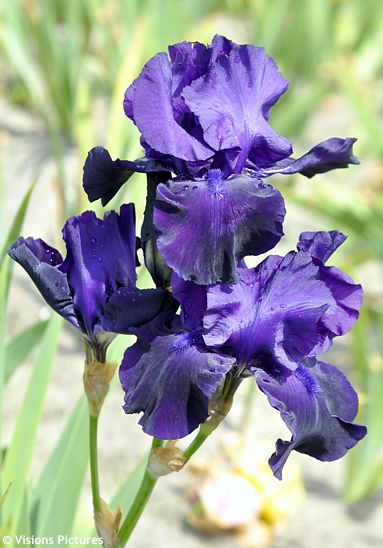
Iris cultivar Storm Center dates back to 1979, and it is easy to see why it remains popular today. I would probably describe its most significant asset as purity of colour. Where many dark bearded irises rely on contrast, veining, or dramatic transitions between shades, this cultivar is built around a remarkably uniform deep violet to blue-violet tone that extends across almost the entire flower, including the beard. In iris terminology, it belongs among the so-called self-coloured cultivars, meaning the standards and falls display essentially the same colour. The large blooms have gently ruffled petals with a velvety texture, shifting with the light from dark inky hues to rich royal purple. Plants reach approximately 95 cm in height and carry themselves with a notably calm, almost majestic presence when in flower. In temperate climates, flowering usually begins in the second half of May and continues into the first half of June, although exact timing naturally depends on the progress of spring.
The cultivar was introduced by Schreiner's Gardens in 1979 and received an Honorable Mention from the American Iris Society just two years later. The name Storm Center is highly evocative and, truthfully, somewhat ambiguous. It may refer either to a meteorological centre monitoring storms and other extreme weather events or to the very heart of a storm system itself, often accompanied by skies dramatically coloured in dark shades of blue.
Bearded irises benefit from a certain generosity of space. They are at their best in uncluttered borders, gravel gardens, dry banks, or the front sections of perennial plantings where their rhizomes are not shaded by surrounding vegetation. Thanks to the Mediterranean heritage of their ancestors, they combine beautifully with plants that enjoy similar conditions, including the flower-rich Perovskia, Salvia, Nepeta, and Lavandula. Their sword-like foliage is complemented perfectly by silver-leaved Artemisia, Santolina, and Jacobaea, while Stachys, low-growing Anthemis, or Erigeron make attractive underplantings whose contrasting textures add another layer of interest. On the other hand, if you are looking for a real wow effect, try combining them with Euphorbia or Hebe, whose highly structured, almost stoic yet undeniably majestic appearance provides a striking counterpart. The list of possible companions is, of course, far longer, but when selecting partners always keep in mind the strong foliage and substantial flowers of bearded irises, because when they bloom, they command almost all of the attention. For that reason, planting larger groups of a single cultivar is often more effective than mixing numerous varieties together. In both public and private landscapes, they are particularly valuable for dry sites and areas with limited irrigation, where, once established, they require surprisingly little maintenance.
Last update 04-10-2026
New in assortment - perennial phlox (Phlox 'Koningin Paola' JS QUEEN PAOLA)1.10.2026
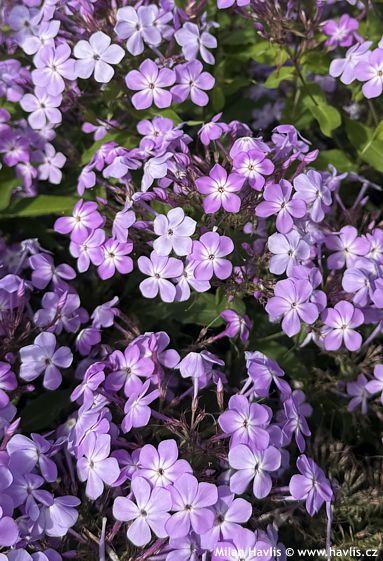
Phlox JS Queen Paola wins you over with several qualities at once. The first thing you notice is its beautifully coloured flowers, blending shades from rosy purple to soft mauve combined with white, forming dense, regular panicles that look like tiny garden lanterns lit from June well into autumn. This leads to another useful trait � extended flowering. It starts in June, the panicles hold for at least a month, and once they are removed, the plant produces new inflorescences from its lateral shoots, allowing it to bloom into September or even October in temperate climates. The habit is compact, forming a firm, healthy clump around 60 cm tall, with foliage that remains clean even in wet summers � almost a small miracle for a phlox.
If you know your phlox well, you may notice that some of the key traits in both appearance and behaviour resemble those of Phlox amplifolia: larger, notably healthy leaves, repeated flowering and slightly looser inflorescences. These features are the reason why P. amplifolia is often used as one of the parents in modern breeding, and although the breeder does not specify the parentage here, JS Queen Paola displays these advantages as well. It was bred by the Belgian plantsman Jan Spruyt and named in honour of Paola Ruffo di Calabria (born 1937), Queen of the Belgians, known for her long-standing support of cultural and horticultural projects. The cultivar is protected under European PBR rights, number 64346 from 2023.
Jan Spruyt (born 1958) is one of the most distinctive European breeders of modern perennials, whose work is not confined to a single genus. Among his introductions you will find anemones, asters, coreopsis, salvias, phlox, echinaceas, geraniums and many others. His approach is rooted in long-term observation of plants in ordinary garden conditions rather than in trial fields alone, resulting in cultivars with exceptional resilience, healthy foliage and stable growth. He established the JS series as a response to the common problems of each perennial group he aimed to improve, and over two decades created a collection that has received numerous European awards, including several ISU Awards for consistent performance across different climates.
Last revision 01-10‑2026
New in assortment - Hakone grass (Hakonechloa macra 'ALL GOLD')30.9.2026
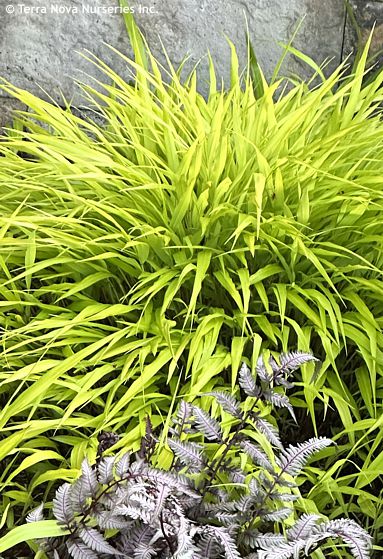
All Gold is a brightly coloured selection of Japanese forest grass, forming soft, cascading mounds with a characteristic, water‑like movement of its foliage. The leaves are narrow and silky, with a vivid lemon‑yellow to chartreuse colour that shifts gently through the season: brightest in spring, deepening into a warmer gold in summer, and turning a soft straw shade in autumn. In partial shade it keeps its cleanest colour, while full sun may lighten it slightly or bring a faint lime tint. It typically reaches 35�45 cm in height and 50�60 cm in width. Growth is slow but steady; the clump gradually expands into an elegant, low cushion that acts as a source of light and colour in darker planting schemes. The flowers are discreet, appearing in late summer as small, lightly drooping panicles that add texture rather than altering the plant�s overall expression.
It is used mainly as a colourful underplanting beneath larger shrubs, such as Japanese maples, multi‑stem birches, smoke bushes or other species with an open lower branch structure. Its bamboo‑like appearance makes it a welcome companion in Japanese gardens, where it complements tightly clipped box and Japanese azaleas, and near stone �streams� it evokes the effect of falling water. It also performs beautifully in containers, where its arching foliage creates a soft, trailing edge. It looks natural on slopes or among rocks, and thanks to its slow spread it requires very little intervention.
Last update: 30-09-2026
New in assortment - perennial phlox (Phlox 'Dophlflawhim' FLAME PRO WHITE)24.9.2026
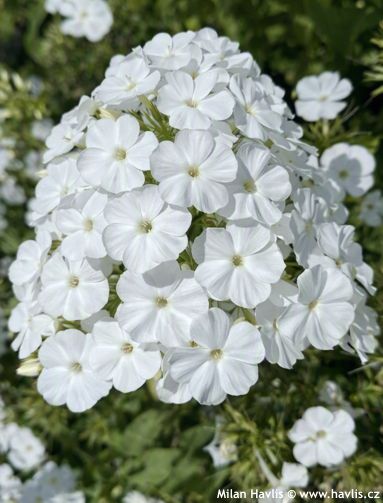
FLAME PRO WHITE perennial phlox is as pure as first snow or a bride�s dress. Its flowers are truly snow‑white, with a gentle, barely perceptible creamy tint at the centre that disappears in full sun and reappears in the evening. It flowers reliably from July to late August and belongs among cultivars capable of producing a second flush: new, smaller panicles form along the stem beneath the main one � which is best removed once spent � giving the plant a lively appearance even in late summer. The stems reach approximately 50 to 60 cm, are firm and upright, and hold their shape even after rain, a key improvement over older cultivars that often bent or broke. The leaves are healthy, fresh green, without a tendency to yellow prematurely, and the plant is self‑cleaning � spent flowers disappear on their own rather than remaining brown and withered on the panicle. FLAME PRO WHITE boasts high resistance to powdery mildew, so in normal summers its foliage remains attractive and healthy until the end of the season.
The Flame series was initiated by Dutch breeder Gosen Bartels around 2006. At that time most garden phloxes were tall, had softer stems and often suffered from powdery mildew in warm summers. Bartels therefore created the Flame series with seven recognised cultivars, each only about 40�45 cm tall, with firm stems, regular panicles and markedly lower susceptibility to mildew than older garden phloxes. And, as appetite grows with eating, he did not rest on his laurels but continued breeding. His goal was larger panicles, cleaner colours and above all stable health even in highly variable summers, when Flame cultivars began to lose resistance. His new follow‑up series was named Flame Pro and differs from the original line in three essential traits:
� even stronger stems that hold their shape even in heavy rain,
� larger and denser panicles, visibly fuller than in Flame,
� reliable resistance to powdery mildew even under more demanding conditions.
Flame Pro has �only� four cultivars � Cerise, Lilac, Soft Pink and White � because it was a targeted selection of specific traits rather than a broad colour palette. All cultivars can flower into September, as after the main flush they produce numerous smaller, secondary panicles along the stem.
Last revision 24‑09‑2026
New in assortment - coneflower (Echinacea PRINCESS� 'Citrus')24.9.2026
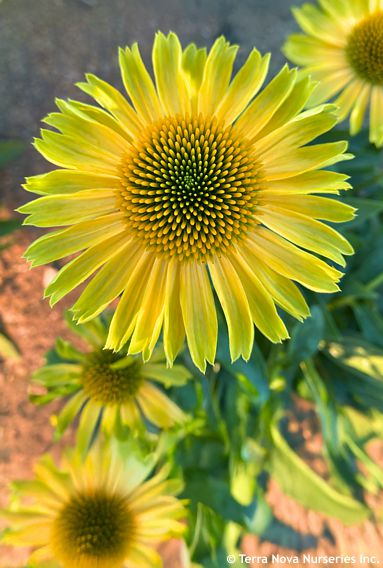
American breeder Harini Korlipara has outdone herself once again. Her coneflower PRINCESS� CITRUS is fantastic. It carries medium‑sized blooms, 6�8 cm across, opening in a warm yellow tone, and at the height of flowering the tips of the petals shift into a soft greenish shade reminiscent of the flesh of a nearly ripe galia melon. And much like that melon, this coneflower is fragrant � fresh, sweet and full. The domed centre, a blend of orange and green, hides plenty of nectar for bumblebees and butterflies, though honeybees will also find their way in. Individual blooms last for two to three weeks, and the cultivar flowers from July until the end of September, sometimes into early October. The leaves are mid‑green, slightly glossy, broadly lanceolate and rough to the touch. The stems reach 40�50 cm and branch well � one stem can carry up to five blooms.
Terra Nova Nurseries of Oregon is one of the most influential contemporary breeders of coneflowers, and behind their work stands my favourite breeder, Harini Korlipara, who in recent years has created a series of distinct lines that have shaped the modern form of the genus. Her work is defined by compact growth, long flowering, stable colour and high uniformity achieved through precise tissue culture. The series PRIMA�, KISMET�, CARA MIA�, DELIGHTFUL�, FRESCO�, REVELATION� and SUNDIAL� regularly receive top awards in American university trials � from Penn State and Colorado State University to UGA Trial Gardens � and many of them have achieved a perfect score of 5.0. Korlipara has established a clear, recognisable style: plants are early, firm, heat‑tolerant, abundantly flowering, rich in colour and able to hold it even in difficult conditions. Thanks to this, Terra Nova�s coneflowers enjoy immense popularity across the United States and, whenever possible, steadily make their way into European gardens as well.
Last update 23-09-2026
New in assortment - coneflower (Echinacea purpurea 'Bullechi 11' SUNMAGIC VINTAGE ORANGE)24.9.2026

SUNMAGIC VINTAGE ORANGE coneflower comes into flower in early July and produces large blooms whose colour recalls the rind of blood oranges � a blend of deep orange and crimson red sometimes described as burnt orange. The flowers are single, measuring 10�12 cm across, and carry a sweet fragrance. Each bloom has a dark red, domed centre rich in nectar, most easily reached by bumblebees and butterflies, though honeybees will also find their way to the outer edge of the cone. Individual flowers last for two to three weeks and the plant blooms until early October. The stems are dark, firm and reach 40�60 cm, branching well even on young plants, which results in a generous number of blooms at one time. The leaves are elongated, narrowly lanceolate, fresh green, slightly rough to the touch and healthy. The plant forms dense, compact clumps. The cultivar is protected by European PBR rights no. 70085 from 2025.
The SunMagic series of coneflowers was created by Hartwig Bull of Germany at Bull Plant Genetics. Bull has long focused on developing varieties with a firm structure, stable colour and reliable growth, a philosophy reflected in his approach breed from a grower point of view. Every new series must be compact, stable, resilient, well‑branching, able to hold its colour even in extreme weather and simply grow well. SunMagic is one of his most successful projects and I believe that its strength lies partly in the fact that Bull breeds exclusively from the botanical species Echinacea purpurea, which is naturally the most robust, rather than from hybrids that can sometimes lose their perennial reliability. Hartwig Bull is also responsible for other internationally successful series: Sunbeckia, which introduced exceptionally large blooms and firm stems in rudbeckias, and SunCatcher, focused on compact sunflowers in intense colours � both regarded as annuals. Thanks to these series, plants from Bull Plant Genetics have performed well in trials from Europe and the United States to Australia, New Zealand, South Korea and Japan, and with established representation in North America they have become a steady part of the nursery trade on both sides of the Atlantic.
Last update 23-09-2026
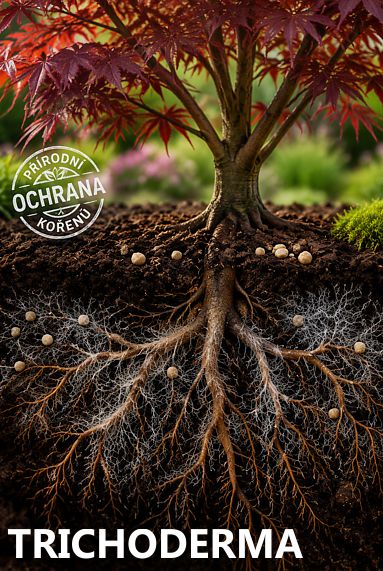
New in assortment - Soil biostimulant with antifungal activity ( TRICHODERMA)22.9.2026
New in assortment - meadow rue (Thalictrum 'Little Pinkie' CENSATION LITTLE PINKIE)20.9.2026
.jpg)
CENSATION LITTLE PINKIE breaks the long-held notion that meadow rues belong exclusively in partial shade. This one certainly does not, and its modest stature is likely part of the reason. Given adequate moisture, it performs remarkably well in full sun, where its compact habit is displayed to best effect and it rewards the gardener with an even greater abundance of brilliantly coloured flowers. The plant forms a genuinely small clump, rarely exceeding 40 cm in height. Dense and tidy, it produces attractively divided foliage that creates an elegant base for the clouds of small, richly lilac-pink to purplish flowers appearing in early summer. These shaggy little flowerheads hover just above the foliage on short stems, allowing them to remain in close visual contact with the softly matt leaves that carry a subtle blue-green tint. The flowers attract bees, hoverflies and other pollinating insects, making the plant not only charming to look at but also a meaningful contributor to the garden ecosystem. Thanks to its compact habit, it is equally at home in herbaceous borders, larger containers, smaller gardens and naturalistic plantings where soil moisture is consistently available.
The designation CENSATION� is a trademark of CNB New Plants, a Dutch company specialising in the discovery, introduction and licensing of new perennial cultivars. Under this label, selected introductions from a wide range of genera are brought together based on their outstanding health, floriferousness, garden performance and commercial potential. Alongside meadow-rues, the portfolio currently includes cultivars of Astilbe, Astrantia, Geranium and Trollium, although the largest representation can be found among Geum and Sedum.
New in assortment - shrub rose - hybrid Persian rose (Rosa 'Korreform 500' SEE YOU IN PURPLE)18.9.2026
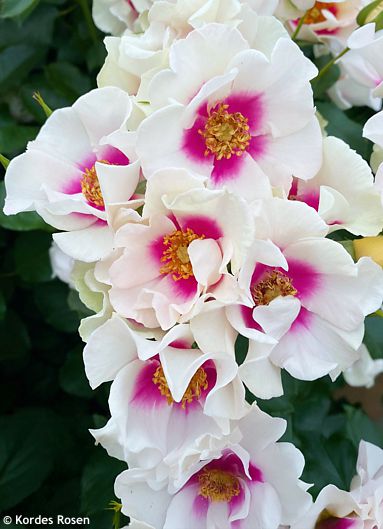
SEE YOU IN PURPLE is a hybrid of the Persian rose (Hulthemia persica) bred by W. Kordes� S�hne in 2018. It carries the typical traits of this group: open, shallow cups with a pronounced purple centre, yellow buds and a gentle colour transition that creates a striking play of tones. The flowers measure 5�6 cm across, are semi‑double, almost white, with firmly arranged petals, and appear in medium‑sized clusters on a compact, upright plant reaching about 70 cm in height and around 50 cm in width. The colour remains stable even in hot weather and the blooms stay open for a long time. The rose flowers repeatedly from June until autumn, and thanks to its strong resistance to black spot and mildew it ranks among the most reliable Persian hybrids today. The foliage is dark green, semi‑glossy and very healthy, and the plant carries few thorns, giving it an elegant appearance even outside the flowering period.
Fragrance � ★★☆☆☆ weaker
Disease resistance � ★★★★★ excellent
Care � standard for floribundas
Flowering � repeat; throughout the season
Hardiness � very good, down to �24 �C
Pruning � standard spring pruning for floribundas
Size � height 0.7 m, width 0.5 m
Breeder � W. Kordes� S�hne, Germany
Awards � ADR (2020)
Legal protection � EU PBR 58436 (2021)
Shrub roses form self-supporting bushes that do not require staking and naturally maintain a balanced shape. In spring they are pruned to three to five buds according to the strength of each stem, which encourages vigorous young growth and prevents congestion. During flowering, regular deadheading is essential: individual faded blooms are removed just below the flower stalk, and once an entire cluster has finished, the whole truss is cut back to the first five‑leaflet leaf; feeding afterwards stimulates a rapid flush of new shoots and buds. Shrub roses need enough space around them for even growth and good air circulation, which keeps foliage healthy and flowering steady. In mass plantings, however, they tolerate close spacing according to the recommendation for each cultivar (three to five plants per square metre).
Last update 18-09-2026
New in assortment - standard rose - floribunda (Rosa 'Korcharblo' NAUTICA)16.9.2026
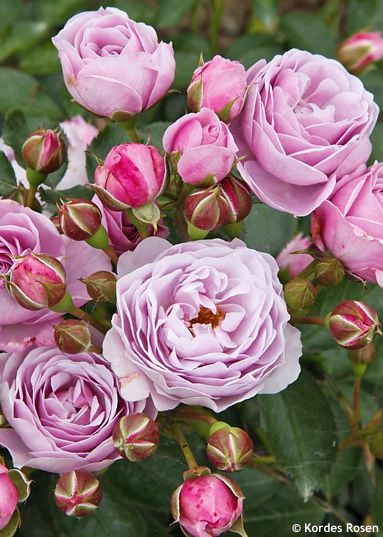
NAUTICA is a floribunda rose from W. Kordes� S�hne, introduced in 2019, carrying an appealing light lilac‑purple, velvety bloom colour and exceptionally healthy foliage. The flowers measure 6�7 cm across, are fully double with firmly arranged petals, and appear in medium‑sized clusters on a compact, upright plant reaching about 70 cm in height and around 50 cm in width. The colour remains stable even in hot weather and keeps its rich tone throughout the season. The rose flowers repeatedly from June until autumn, and thanks to its strong resistance to black spot and mildew it ranks among the most reliable purple floribundas today. The foliage is dark green, semi‑glossy and very healthy. Nautica fits beautifully into modern plantings, smaller gardens and urban front yards, where its colour creates a striking contrast to pale and pastel cultivars.
Fragrance � ★★☆☆☆ weaker
Disease resistance � ★★★★★ excellent
Care � standard for floribundas
Flowering � repeat; throughout the season
Hardiness � very good, down to �24 �C
Pruning � standard spring pruning for floribundas
Size � height 0.7 m, width 0.5 m
Breeder � W. Kordes� S�hne, Germany
Awards � ADR (2020)
Legal protection � EU PBR 51578 (2019)
Standard roses bring a touch of aristocratic elegance to the garden and serve as a clear sign of care, attention and a cultivated gardening style. Their richly flowering crowns, raised on a slender stem, create an airy layer of blooms above the planting, combining beautifully with perennials, lower shrubs and modern architectural elements. They excel in containers on terraces and at entrances, in front gardens, along paths and in formal compositions, where they help establish rhythm, height and clean lines. They require a little more care: in addition to regular dead‑heading and feeding, they need a firm yet as discreet as possible support to keep the stem stable in the wind without spoiling the appearance. In harsh winters, both the crown and the graft union must be protected � before winter, the branches are shortened by roughly half and the entire crown is wrapped in two layers of white fleece, tightened just below the graft. In spring, the fleece is removed and the branches are pruned back to 3�5 buds.
Last update 21-06-2026
New in assortment - shrub rose - floribunda (Rosa 'KORfloci23' MOIN MOIN� (�Pink Flower Circus�))16.9.2026
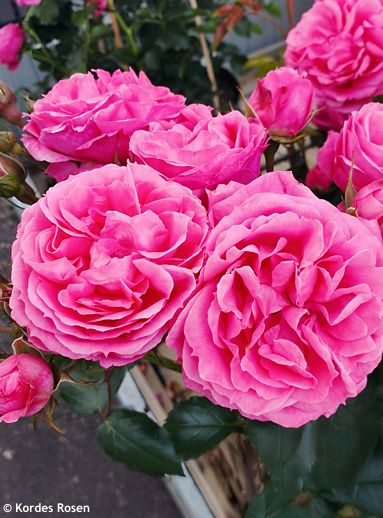
MOIN MOIN� is a modern floribunda rose bred by W. Kordes� S�hne and introduced in 2011. It stands out for its exceptionally abundant flowering, compact growth and stable pink colour that holds well even in hot weather. Its name comes from the northern German greeting �moin moin�, common in Hamburg, Frisia and the coastal regions, expressing a friendly, playful and informal way of saying hello. The rose reflects exactly this character � fresh, cheerful and light. The blooms measure 5�6 cm across, are rounded, fully double to very full, and gradually open into shallow cups. They appear in large clusters on a dense, upright plant reaching about 60 cm in height and around 50 cm in width. The medium to raspberry pink colour remains stable throughout the season. It flowers repeatedly from June until frost, and the blooms tolerate rain and wind very well. The foliage is dark green, glossy and highly resistant to black spot and mildew, confirmed by the ADR award from 2015. Thanks to its compact habit, it is ideal for smaller gardens, urban front yards, terraces and containers.
Fragrance � ★★☆☆☆ weaker
Disease resistance � ★★★★★ excellent
Care � standard for floribundas
Flowering � repeat; throughout the season
Hardiness � very good, down to �24 �C
Pruning � standard spring pruning for floribundas
Size � height 0.6 m, width 0.5 m
Breeder � W. Kordes� S�hne, Germany
Awards � ADR (2015)
Legal protection � EU PBR 34979 (2013), USA PP23558 (2013)
Shrub roses form self-supporting bushes that do not require staking and naturally maintain a balanced shape. In spring they are pruned to three to five buds according to the strength of each stem, which encourages vigorous young growth and prevents congestion. During flowering, regular deadheading is essential: individual faded blooms are removed just below the flower stalk, and once an entire cluster has finished, the whole truss is cut back to the first five‑leaflet leaf; feeding afterwards stimulates a rapid flush of new shoots and buds. Shrub roses need enough space around them for even growth and good air circulation, which keeps foliage healthy and flowering steady. In mass plantings, however, they tolerate close spacing according to the recommendation for each cultivar (three to five plants per square metre).
Last update 16-09-2026
New in assortment - shrub rose (Rosa 'KORcoptru' ROSENSTADT FREISING)16.9.2026
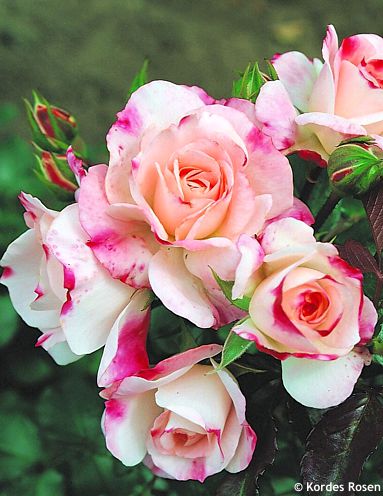
ROSENSTADT FREISING is a robust and striking shrub rose from the Heckenzauber� collection, introduced by W. Kordes� S�hne in 2003. It is valued for its distinctive three‑coloured blooms combining a pure white base with a carmine red edge and fine pink speckling. The flowers measure 6�7 cm across, are semi‑double to double, and appear in large clusters on an upright, naturally compact plant reaching about 120 cm in height and around 80 cm in width. It flowers repeatedly throughout the season and, thanks to its stable growth, forms a long‑lasting decorative feature in borders, parks and urban plantings. The foliage is glossy, healthy and highly resistant to fungal diseases, confirmed by the prestigious ADR award from 1996 and several international medals (Kortrijk, Monza, Rome). Its vigour and resilience make it suitable even for warmer sites, and it tolerates short periods of drought.
Fragrance � ★★☆☆☆ weaker
Disease resistance � ★★★★★ excellent
Care � standard for shrub roses
Flowering � repeat; throughout the season
Hardiness � very good, down to �24 �C
Pruning � standard spring pruning for shrub roses
Size � height 1.2 m, width 0.8 m
Breeder � W. Kordes� S�hne, Germany
Awards � ADR (1996), silver medals Kortrijk, Monza, Rome
Legal protection � EU PBR 14514 (2003)
Shrub roses form self-supporting bushes that do not require staking and naturally maintain a balanced shape. In spring they are pruned to three to five buds according to the strength of each stem, which encourages vigorous young growth and prevents congestion. During flowering, regular deadheading is essential: individual faded blooms are removed just below the flower stalk, and once an entire cluster has finished, the whole truss is cut back to the first five‑leaflet leaf; feeding afterwards stimulates a rapid flush of new shoots and buds. Shrub roses need enough space around them for even growth and good air circulation, which keeps foliage healthy and flowering steady. In mass plantings, however, they tolerate close spacing according to the recommendation for each cultivar (three to five plants per square metre).
Last update 16-09-2026
New in assortment - standard rose - floribunda (Rosa 'Korploban' CREMOSA)16.9.2026
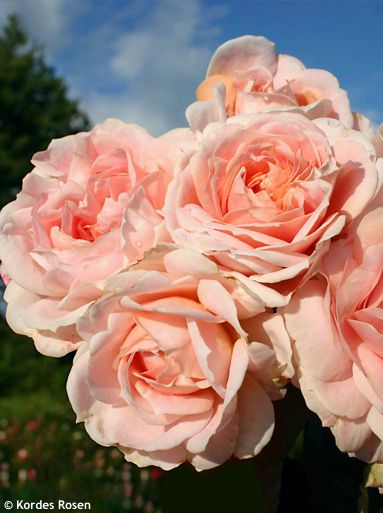
CREMOSA is a modern floribunda rose bred by Wilhelm‑Alexander Kordes and introduced by W. Kordes� S�hne in 2018. It combines nostalgically full blooms with outstanding health and reliable repeat flowering. The flowers measure 6�7 cm across, carry a high petal count and appear in smaller clusters on a firm, compact plant reaching about 70 cm in height and around 50 cm in width. The soft apricot colour gives the rose a calm, elegant presence, fitting both romantic borders and contemporary plantings. The fragrance is clearly noticeable and complements the appearance of the blooms. Cremosa shows excellent resistance to fungal diseases, confirmed by the prestigious ADR award in 2016, and thanks to its stable performance it belongs among floribundas that look refined yet remain easy to grow.
Fragrance � ★★★★☆ strong
Disease resistance � ★★★★★ excellent
Care � standard for floribundas
Flowering � repeat; throughout the season
Hardiness � excellent, down to �28 �C
Pruning � standard spring pruning for floribundas
Size � height 0.7 m, width 0.5 m
Breeder � W. Kordes� S�hne, Germany
Awards � ADR (2016)
Legal protection � EU PBR 58396 (2021)
Standard roses bring a touch of aristocratic elegance to the garden and serve as a clear sign of care, attention and a cultivated gardening style. Their richly flowering crowns, raised on a slender stem, create an airy layer of blooms above the planting, combining beautifully with perennials, lower shrubs and modern architectural elements. They excel in containers on terraces and at entrances, in front gardens, along paths and in formal compositions, where they help establish rhythm, height and clean lines. They require a little more care: in addition to regular dead‑heading and feeding, they need a firm yet as discreet as possible support to keep the stem stable in the wind without spoiling the appearance. In harsh winters, both the crown and the graft union must be protected � before winter, the branches are shortened by roughly half and the entire crown is wrapped in two layers of white fleece, tightened just below the graft. In spring, the fleece is removed and the branches are pruned back to 3�5 buds.
Last update 16-09-2026
New in assortment - stonecrop (Sedum 'Pldaz2018' SUNSPARKLER� PLUM DAZZLED)15.9.2026
.jpg)
PLUM DAZZLED stonecrop from the SUNSPARKLER� series, bred by Chris Hansen in Michigan, belongs among the most colour‑attractive varieties. Its young spring foliage emerges in a deep plum shade with a matte finish, as each leaf is covered with a fine waxy layer that gives it a lightly frosted appearance. In late summer it produces dense clusters of small pink flowers, creating a gentle yet unmistakable contrast with the dark foliage. The flower colour is striking, but unlike some other cultivars � such as the neon‑bright FIRECRACKER from the same series � it remains calm and refined, like pink pearls set against dark velvet. The inflorescences are firm, abundant and highly attractive to bees and bumblebees. The leaves are small and fleshy, and during flowering they show a blend of deep maroon tones and dark olive‑green. The habit of the plant reflect one of its parents, Sedum cauticola, a low, slightly mat-forming species with small leaves, while the second parent, Hylotelephium telephium, contributes generous flowering and stronger stems.
In the garden, the SUNSPARKLER� PLUM DAZZLED stonecrop works well as a low groundcover for sunny, dry sites, where it forms a dense carpet of colour with late summer flowering. It performs reliably in gravel borders and prairie plantings, where its dark foliage highlights lighter perennials such as catmint, yarrow, sage or ornamental grasses. It also combines well with other succulents, including sempervivums, delospermas or low thymes, which appreciate the same soil conditions. Next to plants with silvery foliage, such as wormwood, helichrysum or senecio, it acts as a strong contrasting element. In containers it keeps its shape and colour throughout summer and forms an attractive spill, making it suitable for terraces and balconies. Thanks to its late flowering it provides bees and bumblebees with a valuable source of nectar at the end of the season. The cultivar is protected by European PBR No. 55351 from 2016.
American plant breeder Christopher M. Hansen is the kind of person who can ignite not just a spark but a whole firework of enthusiasm for plants even in people who previously thought that �succulents are just pebbles with leaves�. That�s why his friends and colleagues call him Sparky. His passion began at the age of five, when he collected his first houseleeks, and he hasn�t stopped since: he went through the Missouri Botanical Garden, Longwood Gardens, and Wayside Gardens, where he learned the craft in depth. Today he leads his own company and team at Garden Solutions and introduces series that carry exactly his kind of energy � SunSparkler� sedums, Chick Charms� sempervivums, Gnome Domes� orostachys, and even the Winter Thriller� hellebores, which were in fact his first major success. Sparky is a breeder who tests plants under extreme conditions, loves colour, contrast, and playfulness, and aims to bring joy back into gardens. His projects are not just about genetics � they are about helping people fall in love with plants as spontaneously as he once did, and that resonates with me deeply.
Last update 16-09-2026
New in assortment - stonecrop (Sedum SUNSPARKLER� FIRECRACKER)10.9.2026
.jpg)
FIRECRACKER is another remarkable low‑growing stonecrop from the SUNSPARKLER� series bred by Chris Hansen in Michigan, USA. In late summer it produces dense clusters of small pink flowers that create a soft yet striking contrast to the dark foliage. The flower heads are firm and abundant, attracting bees and bumblebees, so in high summer they appear like a gentle pink shimmer above a maroon carpet. The leaves are fleshy, deep purple to chocolate burgundy, and in spring they emerge olive green with only reddish margins. Its habit is low, compact and wide‑spreading, with no tendency to flop even in rain, which is the main difference from the original species. The name �Firecracker� refers to the sparkling effect of the dark leaves and pale pink flowers, which in midsummer truly resemble a small garden firework.
In the garden, the SUNSPARKLER� FIRECRACKER stonecrop works well as a low groundcover for sunny, dry sites, where it forms a dense carpet of colour with late summer flowering. It performs reliably in gravel borders and prairie plantings, where its dark foliage highlights lighter perennials such as catmint, yarrow, sage or ornamental grasses. It also combines well with other succulents, including sempervivums, delospermas or low thymes, which appreciate the same soil conditions. Next to plants with silvery foliage, such as wormwood, helichrysum or senecio, it acts as a strong contrasting element. In containers it keeps its shape and colour throughout summer and forms an attractive spill, making it suitable for terraces and balconies. Thanks to its late flowering it provides bees and bumblebees with a valuable source of nectar at the end of the season. The cultivar is protected by patents no. 43679 (EU, 2016) and PP26595 (USA, 2016).
American plant breeder Christopher M. Hansen is the kind of person who can ignite not just a spark but a whole firework of enthusiasm for plants even in people who previously thought that �succulents are just pebbles with leaves�. That�s why his friends and colleagues call him Sparky. His passion began at the age of five, when he collected his first houseleeks, and he hasn�t stopped since: he went through the Missouri Botanical Garden, Longwood Gardens, and Wayside Gardens, where he learned the craft in depth. Today he leads his own company and team at Garden Solutions and introduces series that carry exactly his kind of energy � SunSparkler� sedums, Chick Charms� sempervivums, Gnome Domes� orostachys, and even the Winter Thriller� hellebores, which were in fact his first major success. Sparky is a breeder who tests plants under extreme conditions, loves colour, contrast, and playfulness, and aims to bring joy back into gardens. His projects are not just about genetics � they are about helping people fall in love with plants as spontaneously as he once did, and that resonates with me deeply.
Last update 09-09-2026
New in assortment - coneflower (Echinacea 'Balsomselo' SOMBRERO SANDY YELLOW)6.9.2026
.jpg)
SOMBRERO� SANDY YELLOW coneflower wins you over with its understated elegance, which may at first seem almost reserved. But after two to three years, when the clump in the border thickens and begins to flower truly abundantly, you realise that this reserve was only a lure for shyer suitors, much like in courtship. Only in a larger clump does its original beauty fully appear: soft pastel yellow blooms that rightly bear the name SANDY YELLOW. And that sand is certainly not meant as building material, but as sunlit sand on an enchanting beach. You fall for this coneflower just as you fall for that beach you want to return to again and again.
The flowers are single, lightly scented, about 8 cm across, and their centre is adorned with the typical raised, bristly cone offering plenty of nectar for bumblebees and honeybees. They appear from July to September and although their colour softens as they mature, each bloom remains attractive for a good 10�14 days. The leaves are dark green, firm, ovate‑lanceolate, slightly rough to the touch, with pronounced veining that keeps the clump fresh and healthy throughout the growing season. They form a dense basal rosette that gives rise to sturdy stems reaching about 60 cm. The whole clump is dense and fairly compact. The variety is protected by these patents: PP23104 (USA, 2012) and EU 37680 (Europe, 2014).
New in assortment - clasping knotweed (Persicaria amplexicaulis 'EARLY PINK LADY')29.8.2026
.jpg)
Early Pink Lady knotweed will delight those who do not like waiting for summer perennials. It is one of the few exceptional cultivars that can start blooming as early as mid-July if the season starts well. Its slender, spike‑like inflorescences carry deep pink to rosy red buds and soft pink flowers, giving the flowering clump an elegant colour without looking pale. The spikes are usually 12�14 cm long, sometimes a little more, and the flowering stems reach around 70 cm. They remain straight and narrow even in rain, so the plant never looks tousled, even in a dense planting. The clump is compact, firm and quick to knit into the border. The leaves are medium‑sized, usually 10�15 cm long, dark green with a purplish flush when emerging and on the uppermost leaves in full sun. They are matte, which contrasts well with the pink spikes. The shape is broadly lanceolate, with a clearly clasping base that curves gently around the stem, the feature that gives the species its name amplexicaulis = embracing. In the border they soon create and even, attractive surface. It spreads as a tight clump and is not invasive.
Last update 29-08-2026
