










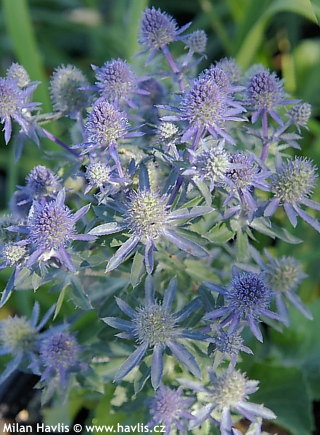
Eryngium planum 'BLUE HOBBIT' dwarf sea holly

 Symbivit Tric (arbuscular)
 Symbivit (arbuscular)
Eryngium
The genus Eryngium, sea holly or eryngo, comprises roughly 230 species distributed from the steppes of Europe and the Mediterranean to the pampas of South America and the dry regions of Asia, making it one of the most diverse genera within the Apiaceae family. Although at first glance it resembles thistles, it is a true member of the umbellifers, a point botanists have emphasised since the 18th century. The genus was described by Carl Linnaeus in 1753 in Species Plantarum, yet its name appears much earlier in the writings of ancient authors, who mentioned sea holly as a medicinal plant with stimulating effects. Interestingly, several species of the genus are known from fossil finds in Europe, indicating a long evolutionary history in dry, sunny habitats. Within botany, minor disputes arise over the precise delimitation of certain South American species, as their morphology overlaps with the genera Azorella and Bolax, but modern molecular studies largely support Linnaeus�s original concept.
Eryngium planum, blue eryngo, is one of those species that have appeared in the European landscape for so long that they have become an almost self‑evident part of dry fields and meadow edges. It originates from regions stretching from the Balkans through the Danube basin to the Baltic and Ukraine, where it grows not only on steppes and rocky slopes but also on fallow land, old paths and vineyards, tolerating heat, wind and poor soils. In European folk medicine, its herb and root were used as a diuretic, a stimulating remedy and an �appetite opener�, which corresponds to its content of various bioactive compounds � phenolic acids, flavonoids, saponins and essential oils. In some areas, such as Transylvania, blue eryngo was traditionally included in mixtures against � not vampires � but whooping cough, making it an interesting example of a regional medicinal plant that never entered formal pharmacy (and thanks to which, presumably, even the vampires stopped coughing). Carl Linnaeus described it in 1753 and placed it among the fundamental species of the genus, whose name he adopted from ancient tradition � eryngion appears already in the works of Theophrastus and Dioscorides for spiny umbellifers with stimulating effects. In modern times, it is also studied as a source of secondary metabolites that may have potential applications in dermatology and phytotherapy.
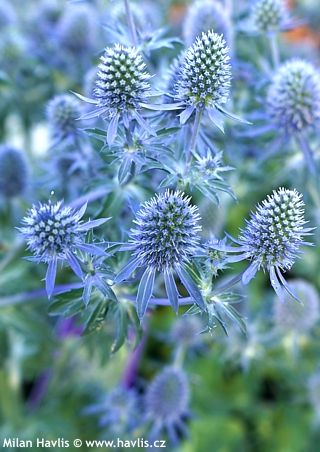
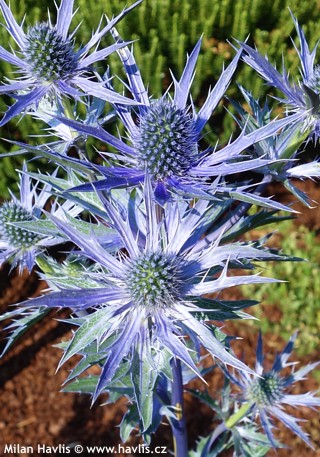
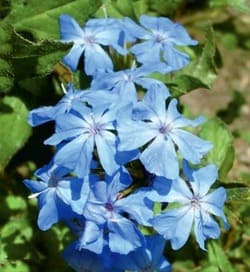
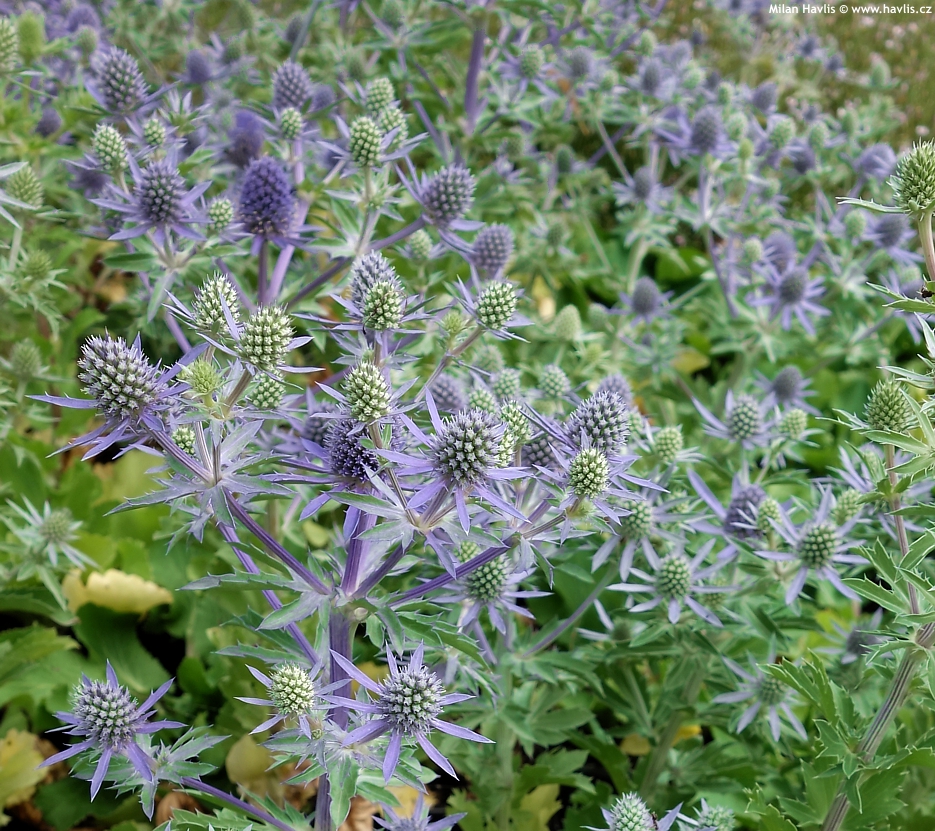
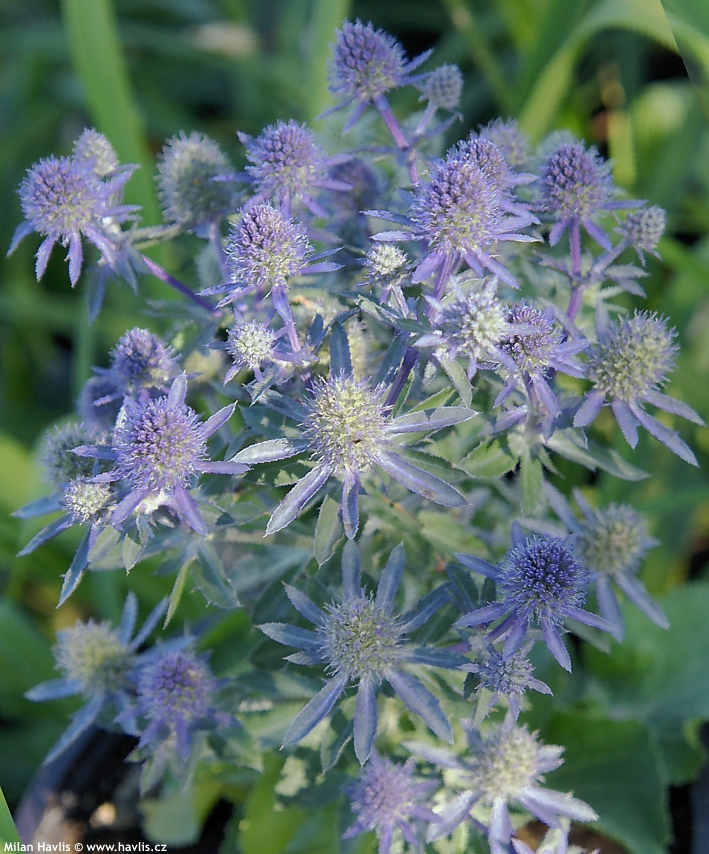
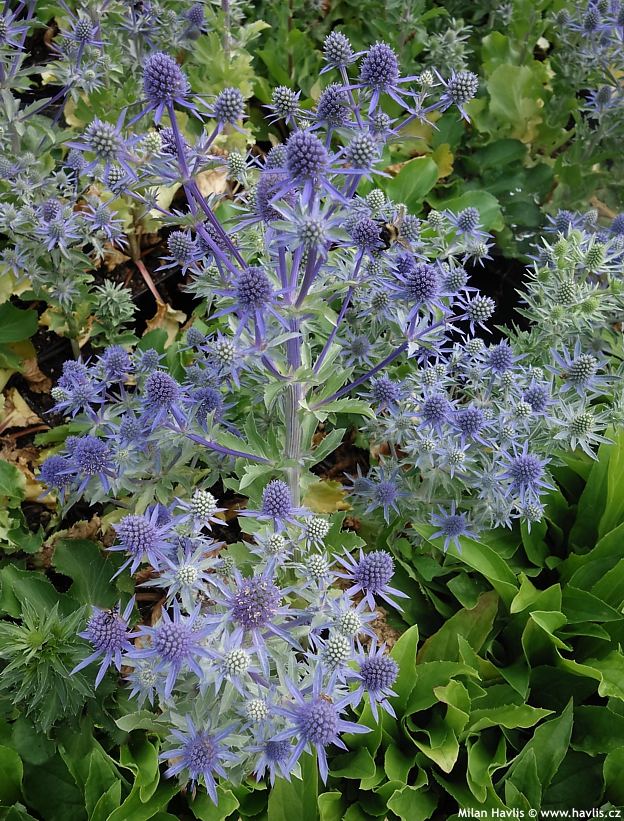
Blue Hobbit is a charming little dwarf among blue eryngoes. It forms low, compact clumps usually 15 to 30 cm tall. The stems are firm, shallowly angular, bluish‑green to steel‑blue, with short branching in the upper part. The inflorescences are conical, strikingly metallic blue, surrounded by narrow, sharply pointed, strongly coloured bracts that in this cultivar appear almost silvery blue. They are smaller than those of the botanical species yet look remarkably prominent thanks to the plant�s proportions. Flowering begins around mid‑June and the heads remain attractive until early August. The basal leaves form a dense, regular rosette: they are round to broadly obovate, firm, bluish‑green, with finely serrated margins. The overall habit is perfectly compact, almost cushion‑like, with the architectural precision typical of this cultivar. �Blue Hobbit� keeps its shape even in heat and wind and, thanks to its low stature, never appears loose or open. Its large basal leaves also effectively protect the crown from excessive watering or heavy summer rain.
Last revision 14-07-2012; 05‑07‑2026
Sea hollies are perennials that require full sun and very well‑drained, poor to stony soil; in rich or heavy soils they quickly lose their compact shape and may rot. They dislike moisture, so drainage and restrained watering are essential � water only during prolonged drought, otherwise natural rainfall is sufficient. Fertilising is unnecessary; higher nitrogen levels lead to soft growth and flopping. Sea hollies are not cut back during the season, only the spent flower heads may be removed if you do not want them to self‑seed; otherwise it is best to leave the inflorescences over winter, as they hold their shape and add structure to the bed. Only taller species and cultivars may look tired after flowering, so it is useful to cut them back close to the ground to encourage fresh foliage that will remain attractive until winter. They are difficult to grow in containers because they need a deep root system and suffer quickly from overwatering. They are tolerant of wind and heat, but young plants can be sensitive to winter wet, so choose a site that does not stay waterlogged. Sea hollies are not edible and may cause mild skin irritation when handled. Their cold tolerance in most species ranges from �25 �C to �30 �C (USDA zone 5), making them reliable perennials for temperate climates.